Church security team insurance protects your ministry from liability, injury, and legal costs.
If you lead or advise a church, you know safety is part of shepherding. I’ve helped many ministries build coverage from the ground up, and I’ve seen what goes wrong when they don’t. In this guide, we’ll unpack church security team insurance with clear steps, real examples, and a simple checklist you can use today.

What is church security team insurance?
Church security team insurance is a set of policies that protect your church and its volunteers or staff who help keep people safe. It covers injuries, property damage, legal claims, and defense costs that can come from security duties. This may include greeters, ushers, medical team members, and armed or unarmed volunteers.
You can buy it as part of a broader church insurance package or as add-on endorsements. The right setup depends on your team’s role, weapons policy, training, and your state’s laws. Good coverage supports ministry work, so leaders can focus on care and mission, not court dates.
Why churches need it today
Churches are open, busy, and visible. That makes them targets for theft, disputes, and rare but serious violence. More often, claims come from simple things like slips, falls, crowding, or poor incident response. When a security volunteer steps in, the church can be pulled into a claim fast.
I’ve seen well-meaning volunteers face lawsuits after breaking up a fight. I’ve seen medical teams blamed when a guest fainted and was hurt in the crowd. Church security team insurance steps in to defend the church, pay covered claims, and keep care going during hard times.

Core coverages to consider
Aim for a layered plan. At minimum, confirm that your base church policy lists security operations. Then add these key parts:
- General liability: Covers bodily injury and property damage claims from premises and operations. Make sure security duties are not excluded.
- Professional liability or errors and omissions: Helps if someone claims your team gave bad directions, bad medical aid, or made a judgment error that led to harm.
- Abuse or molestation coverage: Vital where security intersects with children’s safety and screening. Check limits and defense terms.
- Workers’ comp or volunteer accident medical: Workers’ comp is for employees by law. Volunteer accident policies pay medical bills for injured volunteers, regardless of fault.
- Active assailant/armed intruder: Covers crisis response, counseling, medical expenses, and extra costs tied to violent events. Some include legal defense and PR support.
- Non-owned and hired auto liability: Protects the church when volunteers drive their own cars for ministry or security tasks.
- Cyber and privacy liability: Needed if you run cameras, store video, manage access cards, or keep incident logs with personal data.
- Directors and officers (D&O): Protects leaders for governance decisions tied to safety policies and training.
- Employment practices liability (EPLI): Covers HR-related claims from paid security staff or crossover roles.
- Umbrella or excess liability: Adds extra limits over general liability, auto, and employers’ liability for big claims.
Be sure your church security team insurance names the church as the insured and extends to volunteers, team leads, and pastoral staff who direct them.

Policy structures and how coverage triggers work
Understanding how coverage triggers is key to avoiding gaps:
- Occurrence vs. claims-made: Occurrence policies cover incidents that happen during the policy term, even if reported later. Claims-made policies respond when the claim is made, not when it happened. Many GL policies are occurrence; professional lines can be claims-made.
- Defense inside vs. outside limits: If defense costs are inside the limit, attorney fees shrink your limit as the case runs. Outside-limit defense preserves more money for settlements.
- Primary and noncontributory wording: Needed when your church works with partners or rents space. It sets which policy pays first.
- Additional insured status: Ask vendors, off-duty officers, and event partners to add your church as additional insured where risk overlaps.
- Deductibles and self-insured retentions: Higher retentions can lower premiums but raise your out-of-pocket cost per claim.
- Exclusions to watch: Assault and battery, firearms, crowd control, and professional services can be excluded. Close these gaps or get specialty endorsements.
Ask your broker to map each coverage to a sample incident. It makes complex terms feel simple and helps you spot holes before trouble starts.

Real-world claim scenarios and lessons learned
Here are common events I’ve seen and how insurance can respond:
- Trip-and-fall during a packed service: A guest trips over a radio cable. General liability pays for medical costs and defense if sued. Lesson: Tidy cabling, add mats, and mark hazards.
- Force used to stop a fight: A volunteer restrains a person and causes a sprain. Depending on policy, assault and battery or GL responds. Lesson: Train on de-escalation and holds; document use-of-force rules.
- Child custody dispute at pickup: Team steps in; non-custodial parent sues for false imprisonment. GL and possibly professional liability respond. Lesson: Verify custody orders, have clear release rules, and call police early.
- Medical aid gone wrong: A guest has a seizure; rush crowd causes injury. GL or professional liability may respond. Lesson: Crowd control plans, posted roles, and first-aid training matter.
In one church I advised, a volunteer used a personal baton that was banned by state law. The claim turned messy, and the carrier reserved rights because of the illegal device. We later set a clear banned-items list, logged equipment, and updated training. Claims dropped, and the next renewal was smoother.
Risk management checklist for church security teams
Use this checklist to tighten your plan:
- Written security plan: Include mission, roles, radios, escalation steps, and post orders.
- Use-of-force policy: Keep it simple, legal, and trained. Note when to disengage and call police.
- Background checks: Screen all volunteers. Re-check every 2 to 3 years.
- Training: De-escalation, crowd control, first aid, CPR/AED, radio call-outs, and scenario drills.
- Child protection: Two-adult rule, line-of-sight, secure areas, and custody release steps.
- Incident reporting: Simple forms, photo capture, and secure storage of video.
- Medical readiness: Stocked kits, AED on site, and posted response zones.
- Cameras and signage: Clear signs, legal retention, and privacy safeguards.
- Equipment control: Approved gear list, safe storage, and serial tracking.
- Contracts and coordination: MOUs with local police, roles for big events, and vendor COIs.
- After-action reviews: Short debrief after incidents. Update the plan and retrain.
This list pairs with church security team insurance to reduce risk and prove due diligence if a claim hits.

Costs, limits, and how to set the right amount
Premiums vary with church size, events, location, weapons policy, and loss history. Smaller churches may see modest increases when adding endorsements. Larger campuses or armed teams need broader coverage and higher limits.
Many churches start with $1 million per occurrence and $2 million aggregate on general liability, plus a $1–$5 million umbrella. If you host large events, run a school, or have multiple campuses, you may need more. Work with a broker who writes faith accounts, shares benchmarking data, and explains limit options in plain terms.
To manage cost without risking gaps, raise deductibles you can afford, bundle lines with one carrier, and invest in training. Clean claims history often pays you back at renewal.

How to buy church security team insurance: a step-by-step guide
- Gather details: Headcount, volunteer roles, training logs, incident history, events, and equipment list.
- Clarify weapons policy: Armed or unarmed, approved gear, and storage. Get legal input where needed.
- Choose a broker: Pick one who places faith-based risks and can show carrier options, not just one quote.
- Complete applications: Be honest. Attach your security plan and training proof. It builds underwriter trust.
- Compare quotes: Look at exclusions, sub-limits, defense terms, and endorsements. Do not pick on price alone.
- Tune endorsements: Add active assailant, abuse coverage, non-owned auto, volunteer medical, and cyber if needed.
- Review claims support: Ask how you report claims, who defends you, and average response times.
- Bind and brief: Share proof of insurance with leaders. Train the team on incident reporting and what to say after an event.
- Review yearly: Update limits and policies as your church grows or roles change.
This process keeps church security team insurance aligned with real life on your campus.

Legal, compliance, and church governance considerations
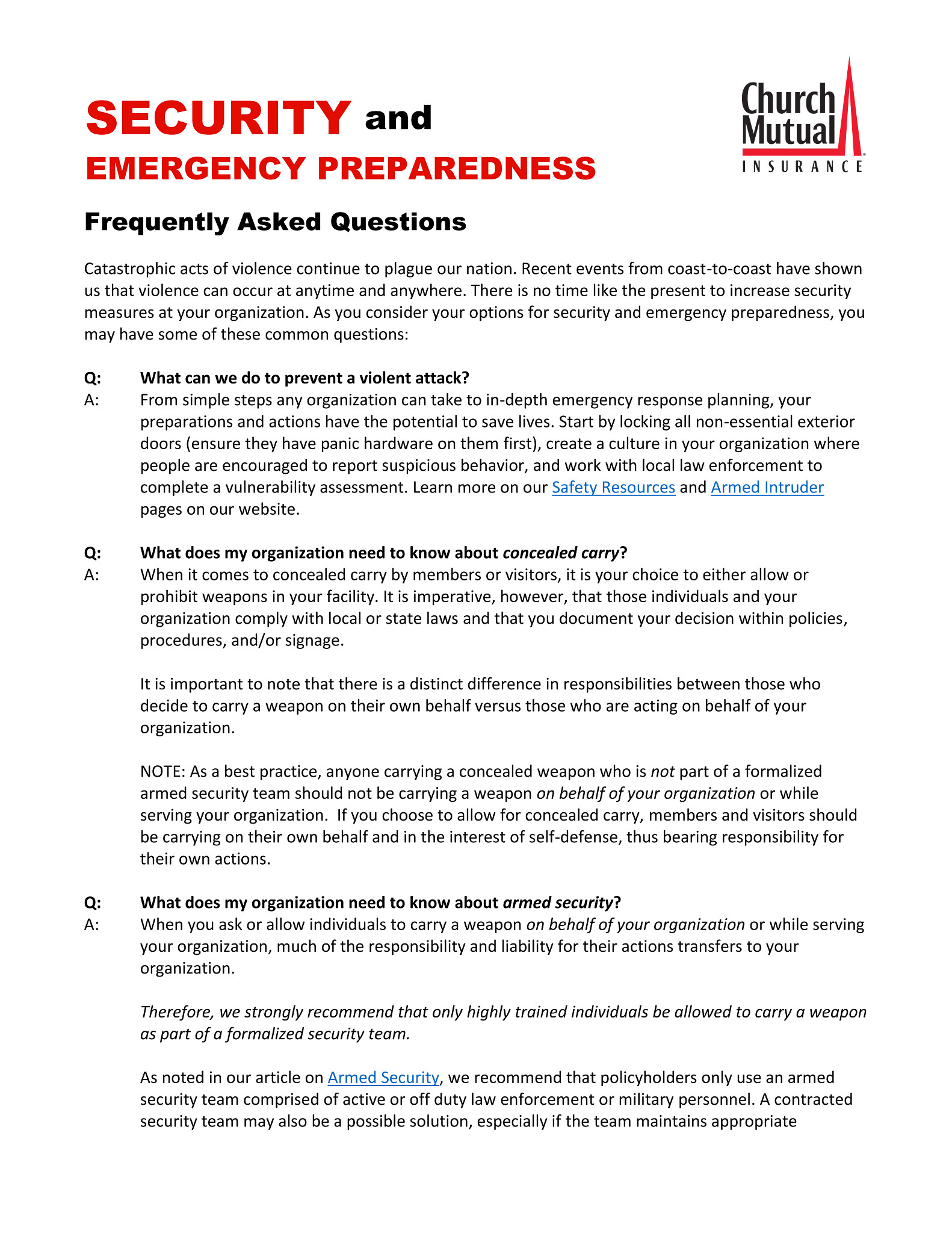
Laws shape what your team can do, especially if weapons are allowed. Some states limit armed volunteers, require licensing, or set strict training rules. There are also rules for camera use, data storage, and public notice.
Good governance matters too. Update bylaws and policies to reflect security roles. Confirm worker status with HR or counsel to avoid misclassifying paid security. Keep vendor contracts tight. Use additional insured status, indemnity wording, and primary/noncontributory language when you partner with venues or event hosts.
Remember, charitable immunity is narrow and not a shield against all claims. Church security team insurance, strong policy language, and steady training form your real safety net.
Common mistakes to avoid
- Assuming the base church policy covers security operations without checking endorsements.
- Allowing armed volunteers without documented training, legal review, or approved gear lists.
- Skipping abuse coverage because “we have background checks.” Screening helps; insurance funds defense.
- Forgetting non-owned auto coverage for volunteers who drive on ministry time.
- Not saving incident reports, photos, and video. Good records can win claims.
- Buying low limits while running large events or multi-site services.
- Choosing price over claims service and faith-sector expertise.
Avoid these traps, and your church security team insurance will work when you need it most.
Sample coverage checklist you can copy
- General liability with security operations included
- Professional liability or E&O for security-related decisions
- Abuse/molestation coverage with separate limits
- Volunteer accident medical or workers’ comp as required
- Active assailant/violent event coverage
- Non-owned and hired auto liability
- Cyber and privacy liability for cameras and logs
- D&O and EPLI for leadership and HR claims
- Umbrella or excess liability to raise limits
- Additional insured and primary/noncontributory endorsements where needed
- Clear exclusions review: assault and battery, firearms, crowd control, medical services
Print this list, meet with your broker, and check each item against your policies. It is a fast way to firm up church security team insurance across your risk profile.
Frequently Asked Questions of church security team insurance
Is church security team insurance different from regular church insurance?
Yes. It focuses on risks tied to safety operations like crowd control and incident response. It adds or adjusts coverages that standard policies may exclude or limit.
Do volunteers need to be named on the policy?
Usually volunteers are covered as insureds while acting for the church. Confirm this in writing and keep a current roster on file.
Will a policy cover armed volunteers?
Many carriers will, but only with strict rules, training, and legal compliance. Some exclude firearms unless you buy a specific endorsement.
How much coverage should our church carry?
Start with at least $1 million per occurrence on GL and add an umbrella. Increase limits for larger campuses, schools, or big events.
Does insurance replace training and background checks?
No. Insurance funds defense and covered claims, but prevention reduces harm and keeps premiums stable. Underwriters reward strong safety programs.
Are medical response teams covered?
They can be, but check professional liability and Good Samaritan laws. Keep training current and document every response.
Do we need cyber insurance just for security cameras?
If you store video or personal data, yes. Cyber coverage helps with privacy claims, breach response, and legal costs.
Conclusion
Church security team insurance lets you serve with confidence. It backs your safety plan, supports your people, and helps your church stand steady after hard moments. Pair strong coverage with simple policies, steady training, and clear records, and you will prevent most pain points before they grow.
Take one step today. Print the checklist, call a faith-focused broker, and close your biggest gaps this week. If this guide helped, share it with your leadership team or leave a comment with your next question.